
Route Briefing • Xi’an Route 02 • Qianling Mausoleum & Famen Temple
Route data reviewed: October 2026 • Road timings estimated via Tencent Maps navigation data (GCJ-02)
While most travelers only venture east to the Terracotta Army, the West Line across the Guanzhong plains holds China’s most profound imperial and spiritual heritage: Qianling Mausoleum, the joint burial mountain of Emperor Gaozong and China’s sole female monarch, Empress Regnant Wu Zetian, paired with Famen Temple, guardian of the sacred Buddha finger bone relic and 2,499 royal Tang treasures. Crossing three municipal jurisdictions (Xi’an, Xianyang, and Baoji), this 245-kilometer regional corridor is where independent public transit entirely breaks down due to non-existent cross-county links. This operational guide provides our field-tested dispatch plan measured strictly from central Xi’an, uniting the morning imperial stone sculptures of Qianling with the afternoon underground crypt treasures of Famen Temple for bespoke private travel in China with dedicated private vehicles, unbundled local dining, and zero shopping commissions.
Trip Essentials • At a Glance
- Driving Distance & Span: Approx. 245 km round-trip across Shaanxi: 86.6 km to Qianling (approx. 100 min), 38.7 km rural transfer to Famen Temple (approx. 55 min), and 118.5 km return via the G30 Expressway (approx. 104 min). Pure driving time: roughly 4 hours. Door-to-door day trip span: 8 to 9 hours departing promptly at 08:00–08:30.
- Two-Monument Pacing: 2.5 hours walking the Sima Sacred Way and visiting the Tang imperial steles at Qianling, followed by an unhurried countryside lunch and 2.5 to 3 afternoon hours exploring the ancient brick pagoda crypt and the Museum of Tang Treasures at Famen Temple.
- Operating Hours & Passports: Famen Temple Museum observes seasonal closing hours (summer 08:00–18:00, winter 09:30–16:30); during winter months, departing Qianling by 13:00 is essential. Original physical foreign passports must be carried for real-name gate entry.
Route Geography & Logistics
Connecting Xianyang and Baoji: The 245 km West Corridor
Starting from central Xi’an hotels, this full-day loop heads west across the fertile Wei River valley into Xianyang and Baoji. Leg 1 journeys northwest via the G70 Fuyin Expressway for 86.6 km (approx. 100 min) to Mount Liang in Qian County. Leg 2 cuts southwest across rural farmland routes for 38.7 km (approx. 55 min) connecting Qianling directly to Famen Town in Fufeng County. Leg 3 completes the loop back to Xi’an via the G30 Lianhuo Expressway, covering 118.5 km in roughly 104 minutes.
Why Independent Public Transit Fails on the West Line
Unlike the East Line where suburban rail reaches Lintong, the West Line lacks any direct high-speed rail or subway connection between Qianling and Famen Temple. Public transit travelers must take an early bus from Xi’an West Bus Station to Qian County (2 hours), take a local minibus up the mountain to Qianling, return to Qian County bus station, wait for infrequent rural county minibuses to Fufeng (which run with multi-hour gaps and terminate early in the afternoon), and hire another local taxi to reach Famen Temple.
Attempting this journey on public buses consumes 6 to 7 hours in transfers and waiting alone, almost always resulting in arriving at Famen Temple after its 16:30 winter ticket cut-off. Ride-hailing apps (Didi) readily take passengers from Xi’an out to Qianling, but finding a driver willing to accept a trip between Qian County and Famen Temple—or finding a ride back to Xi’an from rural Fufeng in the late afternoon—is notoriously unreliable.
A dedicated private vehicle is the only realistic way to link both monumental sites seamlessly within a single day. Your chauffeur coordinates the highway transitions, keeps your luggage safe in the trunk throughout both stops, and provides a peaceful ride back to Xi’an where you can sleep comfortably on the return expressway leg.
Imperial Necropolis Field Guide
Qianling: Joint Imperial Tomb, The Uninscribed Stele & Stone Guardians
Located on the three-peaked Mount Liang in Qian County, Qianling Mausoleum is unique in Chinese history: it is the only imperial tomb where two reigning monarchs—husband and wife (Emperor Gaozong Li Zhi, who reigned 649–683 AD, and Empress Regnant Wu Zetian, who reigned 690–705 AD)—are buried together in the same mountain chamber. The scenic area admission is approx. 100 RMB (high season) / 80 RMB (low season).
The Unopened Tomb: 17 Failed Excavations & 400,000 Shovels
Archaeologists widely recognize Qianling as the only Tang Dynasty imperial mausoleum whose underground palace has never been breached by tomb raiders. Historical records chronicle at least 17 recorded attempts to loot the mountain tomb. During the late Tang Dynasty rebellion, warlord Huang Chao commanded an army of 400,000 men who dug a massive trench 40 meters deep across the mountain flank for over a month, moving half the hillside without ever discovering the subterranean stone entrance sealed with iron-clamped molten lead blocks.
The Sima Sacred Way & The Paradoxical Warrior Statues
Ascending the monumental Sima Sacred Way flanked by twin southern watchtowers (Nipple Peaks), visitors walk among 120 life-sized stone sculptures dating back over 1,300 years. Observe the giant guardian figures: the stone warriors stand leaning on immense iron-hilted broadswords, yet they wear the flowing court robes of civil ministers—a symbolic expression of the Tang Empire’s ideal harmony between military might and civil governance.
The Shushengji Stele & Wu Zetian’s Uninscribed Stele
At the northern terminus of the Sacred Way stand two towering monoliths facing each other across the path. To the west rises the Shushengji Stele (述圣纪碑 / Record of the Saintly Sovereign), composed of seven interlocking stone sections symbolizing the sun, moon, and five elements. The eulogy was composed by Empress Wu Zetian herself and written in the calligraphy of Emperor Zhongzong. Originally containing over 5,600 characters filled with pure gold powder, approximately 1,600 characters remain legible after thirteen centuries of weather exposure.
Directly opposite stands the famous Uninscribed Stele (无字碑 / Wordless Stele), a colossal 7.5-meter limestone monolith carved with eight coiled dragons. Defying imperial tradition, Wu Zetian ordered that no epitaph be inscribed upon her death, proclaiming that her merits and errors should be judged entirely by later generations. Yet, inspect the stone surface closely up close: it is far from blank. Over hundreds of years from the Song to the Ming Dynasties, scholars and travelers carved countless poems and commentaries across its weathered face.
The 61 Headless Foreign Envoys
Just north of the steles stand the 61 Foreign Envoys (六十一蕃臣像), representing royal ambassadors and heads of tributary states who attended Emperor Gaozong’s state funeral in 683 AD. Clothed in tight Central Asian tunics with wide belts, each figure once had their name, official title, and home kingdom carved into the back of their robes (several inscriptions remain decipherable). Intriguingly, every single stone head is missing—broken off during historical earthquakes (including the devastating 1556 Shaanxi earthquake) or deliberate past vandalism.
Midday Dining & Countryside Transfer
Lunch at Your Leisure in Qian County & Rural Drive to Famen
Descending Mount Liang around 12:00, your driver picks you up at the lower parking bay. Lunch is strictly unbundled: you have 100% menu autonomy to order whatever suits your taste and dietary preferences, with zero forced banquet arrangements or commercial souvenir stops.
Qian County is celebrated for its historic local culinary triad: crisp, dry-baked Qianxian Guokui flatbread (traditionally carried by tomb laborers for its long shelf life), steaming bowls of silky Doufunao (soft tofu pudding ladled with chili oil and fragrant sesame broth), and hand-pulled sour and spicy noodles. For travelers who prefer mild fare, clean local restaurants offer freshly stir-fried farm vegetables, braised chicken, and delicate wonton soups.
Departing Qian County by 13:00, an enjoyable 38.7-kilometer rural drive (approx. 55 minutes) cuts through apple orchards and agricultural hamlets across the Guanzhong plain, arriving smoothly at Famen Temple around 14:00.
Sacred Sanctuary Field Guide
Famen Temple: Tang Underground Crypt & Empress Wu’s Gold Skirt
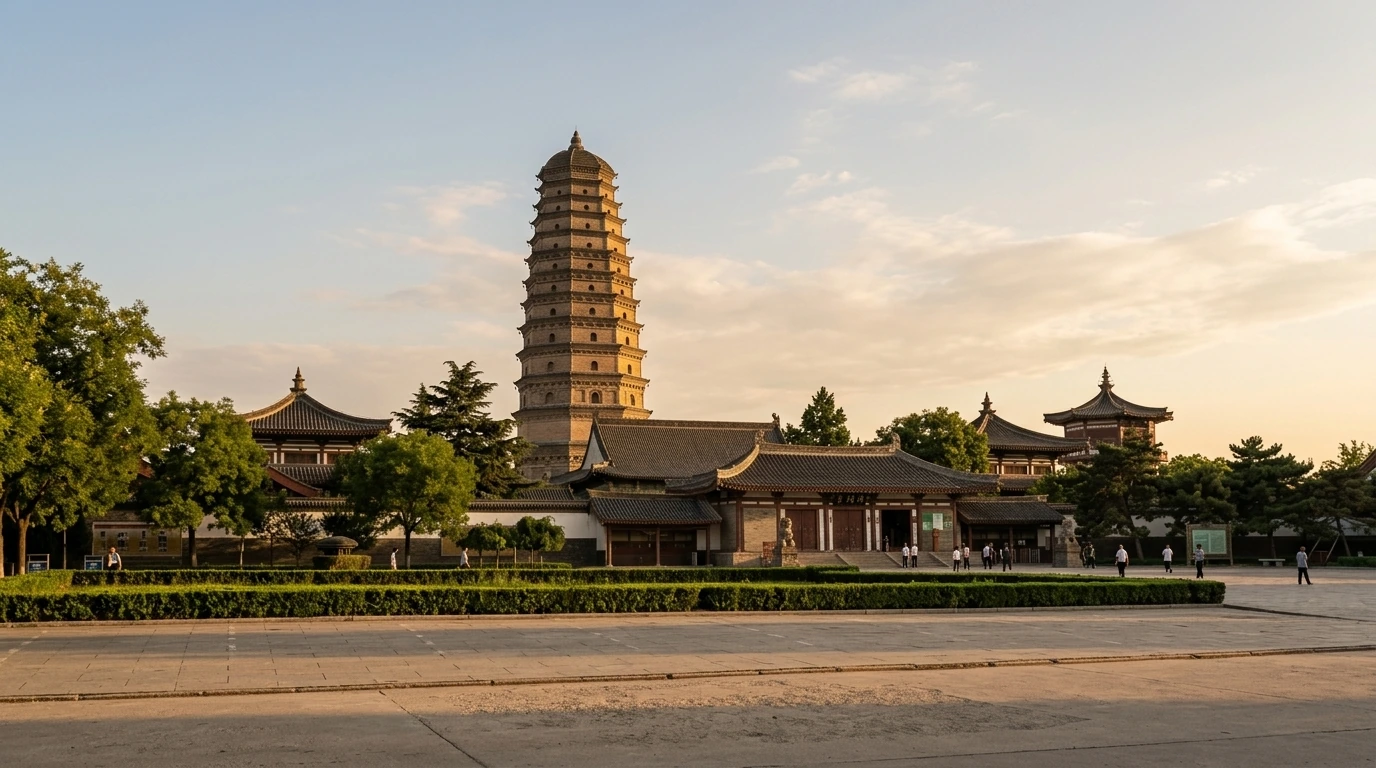
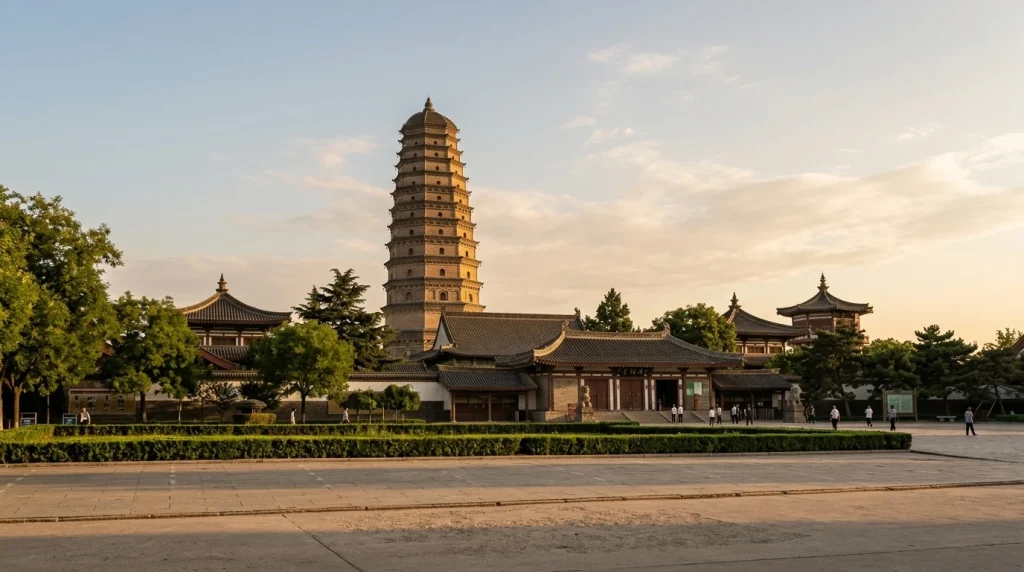
Originally established in the late Eastern Han Dynasty as the King Ashoka Temple, Famen Temple in Fufeng County is revered as the ancestral home of Buddhism in northern China. The unified ticket costs approx. 100 RMB (with optional internal electric golf cart for approx. 30 RMB along the 1.2-kilometer Fo Guang Avenue). The temple comprises three distinct areas: the historic Old Monastery with the brick True Relic Pagoda, the Museum of Tang Treasures, and the modern Namaste Dagoba.
The 1981 Pagoda Collapse & The 1987 Crypt Excavation
On August 24, 1981, following torrential summer rains, the 47-meter-tall octagonal Ming brick pagoda suffered a catastrophic partial collapse, with half its structure shearing away vertically while the remaining half stood miraculously upright. In April 1987, while clearing foundation debris to rebuild the tower, archaeologists uncovered a stone entrance slab leading down into the subterranean royal Tang Dynasty crypt, untouched since it was sealed in 874 AD.
Entering the underground crypt passage (5.8 meters long, 2 meters wide across 20 stone steps), look at the floor: over 27,000 Tang Dynasty Kaiyuan Tongbao bronze coins formed a sacred metallic carpet, including 13 extraordinarily rare coins forged from genuine sea tortoiseshell. Behind stone security doors stand two intact stele tablets: the Chronicle Stele and the Inventory Stele, which precisely recorded the 2,499 royal gifts donated by Tang emperors, matching the excavated relics with pinpoint accuracy.
The Museum of Tang Treasures & Empress Wu’s Embroidered Skirt
The adjoining Famen Temple Museum houses the 2,499 royal Tang masterworks discovered in the crypt. Here, your morning visit to Qianling connects with an astounding physical object: the Empress Wu Embroidered Skirt (紫红罗地蹙金绣流云纹裙). Donated personally by Empress Wu Zetian during her imperial pilgrimage to Famen Temple, this crimson silk textile is embroidered with gold wire so exquisitely drawn that the finest metallic threads measure just 0.06 millimeters in diameter—thinner than a strand of human hair. It is the only authenticated, surviving piece of Empress Wu Zetian’s clothing in existence.
Other extraordinary national treasures in the museum include:
- The Gilded 12-Ring Monastic Staff (鎏金双轮十二环锡杖): Standing 1.96 meters tall and weighing 2,390 grams, commissioned by Emperor Yizong, this is the highest-ranking Buddhist ceremonial staff in the world and one of China’s 64 tier-one cultural relics permanently banned from foreign exhibition.
- The Gyroscopic Silver Incense Burner (鎏金双蝶团花纹银香囊): A spherical silver pomander equipped with twin concentric gimbal rings that utilize modern gyroscopic equilibrium principles—no matter how the incense ball rolls or inverts, the internal ash bowl remains upright without spilling.
- The Secret Color Celadon (秘色瓷): 14 pale sea-green porcelain vessels whose firing formula remained an unsolved ceramic mystery until the Famen Temple inventory confirmed their imperial identity.
- The Five-Fold Reliquary & White Jade Coffin: Five nested ceremonial chests of silver, gold, and sandalwood, sheltering a miniature white jade casket at its innermost core.
The Namaste Dagoba & The Authentic Finger Bone Relic
At the southern end of the complex stands the colossal Namaste Dagoba (合十舍利塔), completed in 2009 and soaring 148 meters into the sky (equivalent to a 50-story building) in the silhouette of hands clasped in prayer. The genuine middle finger bone relic of Sakyamuni Buddha is enshrined in an underground chamber below this modern monument, elevated for public veneration during major Buddhist holidays and designated calendar dates (subject to the monastery’s official schedule announcements). Concluding your visit around 16:30, your vehicle returns smoothly via the G30 Expressway, arriving back at your central Xi’an hotel by 18:30.
Operational Protocols
Practical Dispatch Notes: Early Departure, Winter Gates & Driver Ethics
Mandatory Early Departure Rule
Because this regional circuit covers 245 kilometers across rural highways and expressways, our dispatch team strongly enforces a departure time between 08:00 and 08:30 from your Xi’an hotel. Departing later creates unnecessary time pressure, particularly during winter months when Famen Temple Museum ceases ticket sales at 16:30.
Original Passport Verification
Both Qianling and Famen Temple enforce real-name passport scanning at security turnstiles. International visitors must carry their physical original passport. Smartphone photos or copies are not accepted at electronic gates.
Dedicated Chauffeur & Zero Shopping Stops
All YouTu Travel tours operate under a strict code of ethics: no commissioned shopping stops—your driver’s only focus is the route. We never divert guests to roadside souvenir stands, herbal medicine outlets, or commissioned jade markets. Your driver focuses exclusively on smooth driving, luggage security, and punctual door-to-door transit.
Traveler Inquiries
Frequently Asked Questions: Xi’an Route 02
How long is the pure driving time on Route 02?
Pure driving time is approximately 4 hours across 245 kilometers (100 min out to Qianling, 55 min connecting to Famen Temple, and 104 min returning to Xi’an via expressway). The total door-to-door span is 8 to 9 hours, allowing 2.5 hours at Qianling, an unhurried lunch, and 2.5 to 3 hours at Famen Temple.
Can this route include an airport transfer to Xi’an Xianyang International Airport?
Yes, exceptionally well. Qianling is located in Xianyang municipality, relatively close to Xi’an Xianyang Airport (XIY). If you are flying into or out of Xi’an, we can begin or end Route 02 directly at the airport terminal, with your luggage locked securely in the trunk throughout the day.
When can we see the authentic Buddha Finger Bone Relic at Famen Temple?
The authentic Buddha Finger Bone Relic is housed in the underground chamber of the Namaste Dagoba and is elevated for public veneration on the 1st and 15th days of each lunar month, major Buddhist feast days, and select national holidays (typically between 10:00 and 16:00, subject to periodic monastery notices). On other days, visitors can view the sacred reliquary crypt and the extensive collection of shadow relics in the museum.
Is Qianling strenuous to walk for seniors?
Qianling’s Sima Sacred Way is a gradual paved incline rather than steep mountain steps. Seniors can take electric carts between the parking lot and the steles, or walk the flat ceremonial avenue at a gentle pace while your driver waits at the designated gate.
Bespoke Shaanxi Chauffeured Day Tours
Reserve Your Private Xi’an Route 02 Day Excursion
Door-to-door hotel pickup, premium vehicle comfort, secure luggage storage, and complete schedule freedom across Xianyang and Baoji. Zero commissioned shopping stops, zero forced group meals—just the grand tombs of the Tang monarchs and the subterranean relics of Famen Temple at your pace.