Route Briefing • Beijing Route 01 • Mutianyu Great Wall & Hongluo Temple
Route data reviewed: October 2026 • Road timings estimated via Tencent Maps navigation data (GCJ-02)
Hosting overseas travellers on a private Beijing excursion comes down to knowing where public transit works well and where private vehicles eliminate immense friction. Inside downtown Beijing (within the Second Ring Road), the subway is rapid, punctual, and bypasses surface traffic—visiting the Forbidden City or the Temple of Heaven on the metro is often faster than sitting in rush-hour traffic. But heading north past the Fifth Ring Road toward the Yan Mountains for the Mutianyu Great Wall and Hongluo Temple, public transit transfers, suburban bus schedules, and uphill walks quickly consume your entire day. This full-length operational guide details Beijing Route 01 measured strictly from Tiananmen Square, pairing the dramatic stone battlements of the Great Wall with the tranquil bamboo courtyards of Beijing’s premier Buddhist sanctuary for bespoke private travel in China with dedicated private vehicles, no commissioned shopping stops, and secure luggage storage in the trunk.
Trip Essentials • At a Glance
- Driving Distance & Span: Approx. 170 km round-trip from central Beijing: 75–80 km to Mutianyu (1.5–2 hours), 18–20 km scenic mountain transfer to Hongluo (30 minutes), and 70–75 km return (approx. 1.5 hours). Pure driving time: roughly 3.5 to 4 hours. Typical door-to-door day trip span: 8 to 10 hours from hotel pickup to evening drop-off.
- Two-Valley Pacing: 3.5 to 4 unhurried morning hours hiking the restored watchtowers of Mutianyu, followed by 2 peaceful, shaded afternoon hours exploring Hongluo Temple.
- Key Deadlines & Entry: Advance online real-name booking is mandatory for Mutianyu; original foreign passports scan directly at turnstiles. Hongluo Temple entrance gates close strictly at 16:00 daily (park clears around 17:00).
Route Geography & Logistics
How to Travel from Tiananmen to Mutianyu and Hongluo Temple
Measured from Tiananmen Square as the official urban benchmark under normal traffic conditions, this full-day journey covers approximately 170 kilometers across three natural legs: the morning run from downtown to Mutianyu North Ticket Plaza takes 1.5 to 2 hours over 75 to 80 km via the Jingcheng Expressway; the midday cross-mountain transfer from Mutianyu to Hongluo Temple covers 18 to 20 km in roughly 30 minutes over scenic rural passes; and the late afternoon highway return spans 70 to 75 km back into central Beijing in about 1.5 hours.
Why Public Bus Transfers Fail Between the Two Valleys
Independent travelers frequently wonder whether public buses can connect both attractions in a single day. In reality, while getting to Mutianyu alone by public transit is possible, combining it with Hongluo Temple by bus almost always breaks down.
Traveling to Mutianyu by bus requires taking the subway to Dongzhimen, boarding Bus 916 Express to Huairou Beidajie (70 min), transferring to local Bus H23 to Mutianyu Roundabout (40 min), and then walking 2.8 km uphill along the highway (35 to 45 minutes) to reach the ticket office. This one-way trip takes roughly 2.5 to 3 hours.
The real logistical hurdle appears when trying to move between Mutianyu and Hongluo Temple. No direct public bus crosses the mountains between the two valleys. Travelers must walk 2.8 km back downhill to Mutianyu Roundabout, board Bus H23 backward 10 stops south into downtown Huairou at Yujiayuan Station (40 min), and then wait for rural Bus H57 heading north to Hongluo. Bus H57 runs with long gaps of two to four hours between afternoon departures. Missing the 14:30 bus means the next departure is at 16:30—well after Hongluo Temple has closed its gates for the day.
A frequent misconception found in generic travel itineraries is that one can casually hop on a quick local bus across the mountains between the two sights. Because of the missing transit link, public transit requires over five hours of combined riding, waiting, and highway walking, virtually guaranteeing that travelers miss Hongluo’s 16:00 gate closure. In contrast, a private vehicle completes the inter-valley transfer in an easy 25-minute rural drive through orchard roads, bypassing transfer bottlenecks entirely.
Great Wall Field Guide
Mutianyu Great Wall: Dual Cable Cars, 544 Steps & Navigation
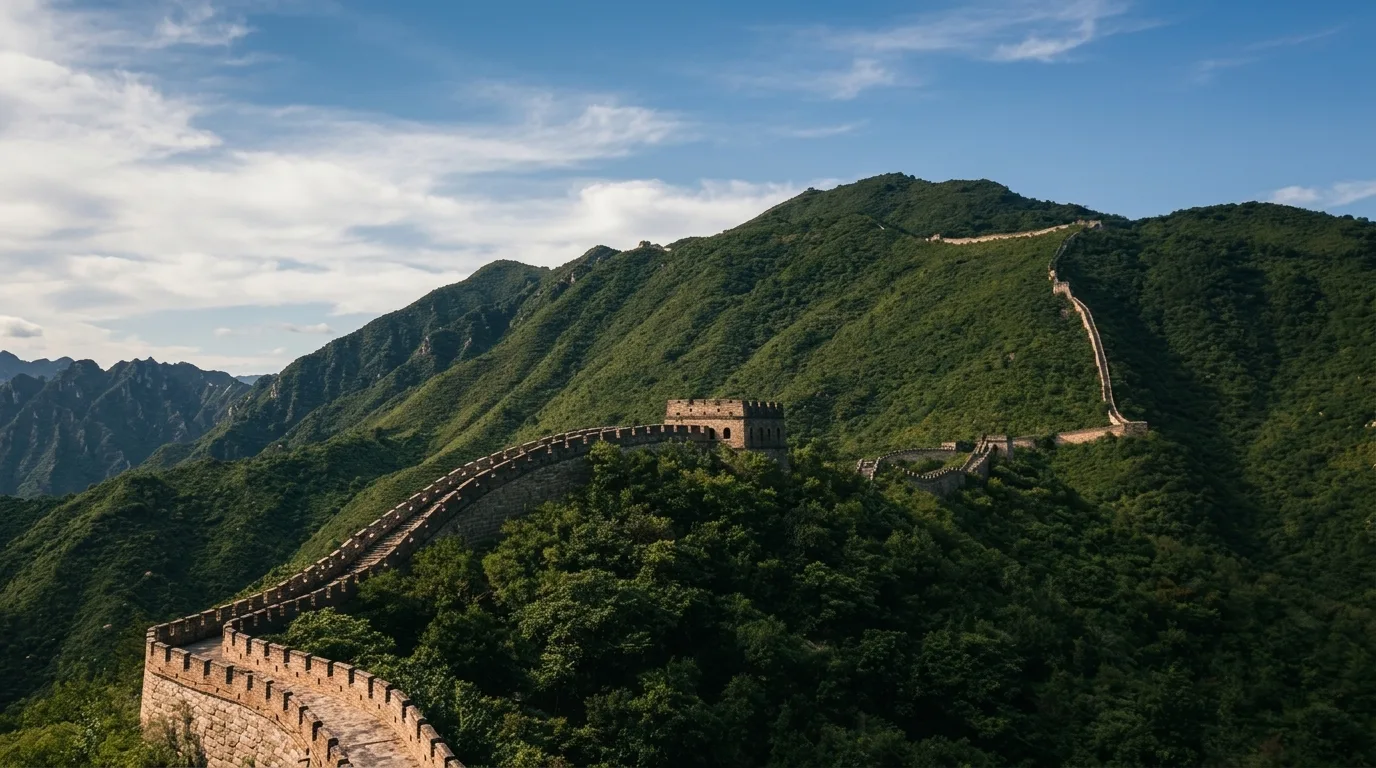
Mutianyu Great Wall boasts over 90% forest coverage and impeccably restored Ming Dynasty stone masonry. Unlike Badaling, which frequently suffers overwhelming crowds, Mutianyu offers space to absorb the landscape calmly.
Dual Cable Car Operators and Shuttle Navigation
After riding the 3 km scenic shuttle bus (15 RMB round-trip), you walk uphill through a pedestrian commercial lane. You will encounter a crowded fork where megaphones continuously announce: “Hikers and cable car passengers keep walking upward! The open chairlift and toboggan are not the cable car!” Many first-time visitors mistakenly join this lower queue thinking it leads to the cable car. If you intend to ride the enclosed cable car, do not stop here—continue walking uphill along the main paved ramp to the North Gate ticket plaza.
Near the cable car boarding pavilion, look for the preserved Red Cable Car Cabin #42. This exact cabin carried US President Bill Clinton and his family during his June 1998 visit to the Great Wall, and remains on permanent display as an iconic photo stop for Western visitors.
Mutianyu features two completely independent transport systems managed by separate companies. Operator A runs enclosed, 6-passenger weatherproof cable cars from the North Gate to Watchtower 14 (140 RMB round-trip, or 100 RMB one-way), ideal for seniors, young children, and windy days. Operator B runs the open two-seater chairlift and German-engineered stainless steel alpine speed toboggan from the South Gate to Watchtower 6 (140 RMB round-trip, or 100 RMB one-way).
A frequent ticket office pitfall is assuming that a single combo ticket covers taking the cable car up to Tower 14 and sliding down the toboggan from Tower 6. In reality, that combination ticket does not exist: because the systems belong to competing commercial companies, ascending by cable car and descending by toboggan requires purchasing two separate single-journey tickets (100 RMB + 100 RMB = 200 RMB total), paying 60 RMB more per person than a round-trip ticket within either single system.
Speed Toboggan Safety, Age Ceilings, and Track Pacing
The toboggan is gravity-fed along stainless steel chutes. Push the central lever forward to accelerate; pull back firmly to brake. Obey track-side marshals waving red flags at tight curves.
Safety regulations are strictly enforced on site: visitors aged 60 and older are barred from riding the toboggan. Staff check physical IDs and passports at both the turnstiles and boarding platforms, turning away seniors on the spot (seniors can descend comfortably via the chairlift or cable car). Children under 10 cannot ride independently and must share a cart with an adult. When boarding your sled at Tower 6, hold the handbrake for an extra 20 to 30 seconds after staff dispatch you to create a safety cushion; launching immediately often causes you to get stuck behind timid riders who brake continuously.
Hiking the Ramparts: Watchtowers 14 through 20
After ascending to Watchtower 14, step onto the western terrace to spot the giant white stone characters embedded into the mountain slope. Inside the tower chamber, an official fabric graffiti wall provides the only legal, protected way to sign your name without damaging Ming bricks. The walk west between Towers 14 and 18 follows broad, gently inclined stone battlements, passing the famous arched doorway of Tower 15.
Approaching Watchtower 19, the rampart narrows into an interior single-file, two-way stone stair where hikers must turn sideways and take turns passing. The push from Tower 19 to Watchtower 20 climbs approximately 500 steep, uneven stone steps at a near 70-degree pitch known as Haohan Slope (Hero Slope). Reaching the summit of Tower 20 rewards you with sweeping 360-degree views across rolling mountain ridges.
Towers 1 through 20 are fully open daily following stone masonry restoration completed in late October 2026, despite legacy notices that still linger on the park’s desktop English website. Directly west of Tower 20, the trail connecting to unrestored wild Jiankou is securely sealed with masonry and warning signs; crossing past this barrier is strictly prohibited.
Coming down Haohan Slope tests leg muscles and knees far more than the climb up. Descend sideways, maintain three points of contact, and hold the stone parapet wall firmly. Active hikers then retrace steps east past Tower 14, continuing along the high ridgeline through Towers 13 to 6 to board the speed toboggan down to the valley. Restrooms are located at Tower 14, Tower 8, and Tower 4; there are no restroom facilities between Towers 14 and 20.
Midday Dining & Scenic Drive
Flexible Countryside Dining & 30-Minute Mountain Transfer
Descending Mutianyu around 12:45, your vehicle waits at Parking Lot 4 with the air conditioning ready. Midday dining is arranged entirely à la carte directly at the venue at your own pace, giving your party complete freedom over menu choices, timing, and dietary preferences (vegetarian, gluten-free, or simple light dining). Your charter rate intentionally unbundles meals so you are never steered into tourist-bus banquet halls or commercial shopping stops.
Huairou’s forested valleys are celebrated for cold-spring rainbow trout (charcoal-grilled or roasted) and sweet chestnuts, prepared fresh to order at quiet countryside lodges away from tour bus crowds. Around 13:45, a peaceful 18-kilometer drive along the Huaihuang and Hongluosi mountain passes winds past orchard hamlets and wooded streams, delivering you refreshed to Hongluo Temple around 14:15.
Buddhist Sanctuary Guide
Hongluo Zen Temple: Ancient Ginkgoes, Guanyin Path & Return
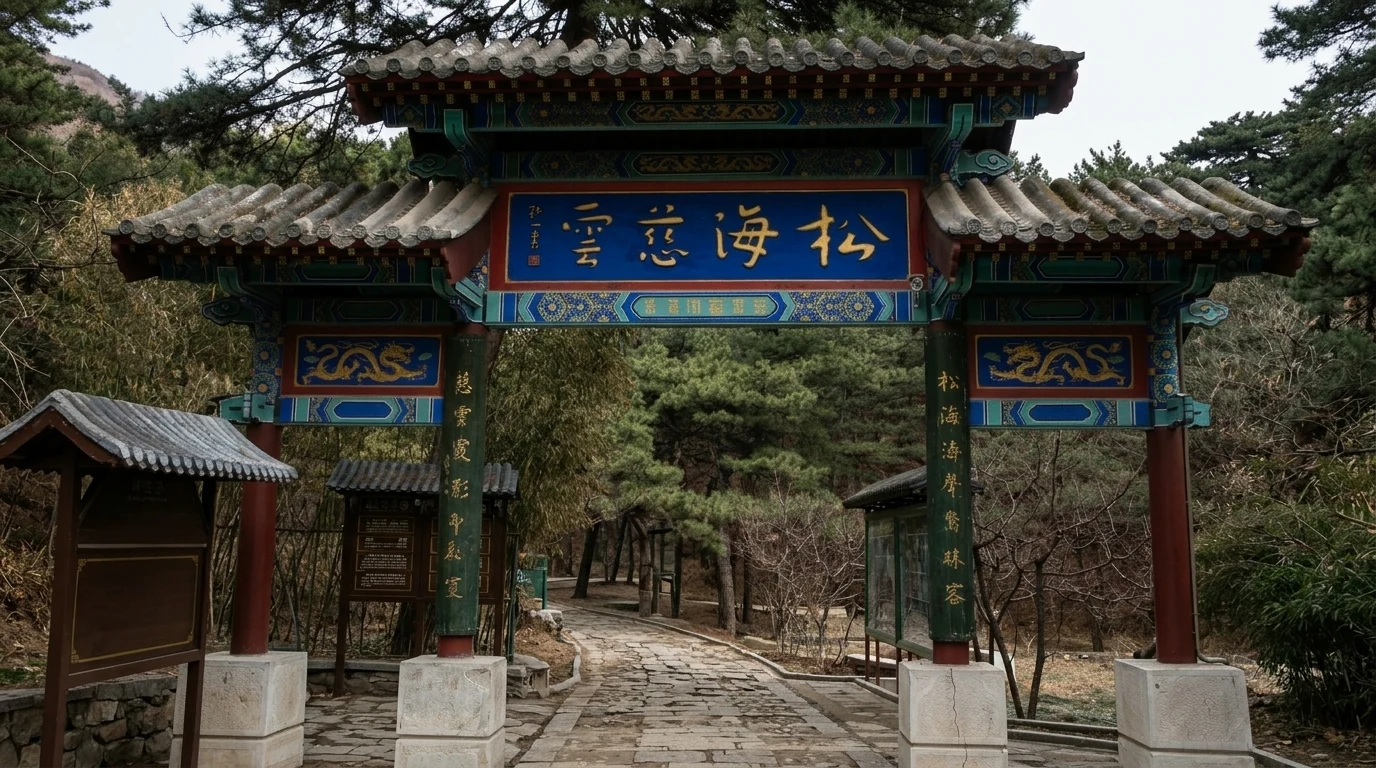
Founded in 338 AD during the Eastern Jin Dynasty, Hongluo Temple is northern China’s premier Buddhist sanctuary, famed for blessings of marriage, family, and peaceful longevity. Set against the southern slopes of Mount Hongluo amidst million-stem bamboo groves and thousand-year-old pine canopies, it serves as the essential afternoon counterweight to the Great Wall. After climbing 500+ stone steps at Mutianyu in the morning, Hongluo Temple is not meant to be another exhausting mountain hike—it is a gentle, shaded forest sanctuary walk with zero aggressive tourist traps.
Arrival Strategy and Parking Lot 2 Navigation
Unlike Mutianyu where visitors must wait for an internal 3 km shuttle bus, Hongluo Temple has zero internal shuttles. Private vehicles pull directly up to the mountain entrance, allowing travellers to step out, cross the street, and enter the ticket turnstiles in under two minutes.
Driving up the mountain approach, the first gate on the left is strictly an exit-only barrier with tire spikes. Continue straight past Lot 1 until you reach the prominent red ceremonial archway, then turn left into the official Lot 2 entrance. Parking toward the lower downhill slope places you just 80 meters from the ticket turnstiles. Parking is a flat 20 RMB per vehicle with unlimited duration.
Admissions, Senior ID Rules, and the 16:00 Gate Cutoff
Regular adult tickets cost 54 RMB per person; children under 6 or under 1.2 meters enter free. Hongluo Temple’s 65+ free entry policy strictly requires a domestic Beijing Municipal Assistance Card, which foreign travellers cannot hold; international seniors should budget for the standard 54 RMB adult ticket to avoid discrepancies at the turnstiles.
Crucially, the park enforces a strict cutoff at 16:00 daily when ticket sales and gate turnstiles close entirely (park grounds clear around 17:00). Entering around 14:15 guarantees two full, unhurried hours to complete the complete sanctuary loop.
The Sanctuary Forest Loop: Ginkgoes, Guanyin Path & Huicheng Hall
Passing the entrance gate, take the left path through the Imperial Bamboo Grove past the “Strike the Coin Hole” pool and bubbling Hongluo Spring, following shaded stone steps up to the mountain gate. Approaching the ramp, peek into the glass greenhouse side door beside the stairs to discover a vibrant wall of crimson bougainvillea in full bloom—an exceptional portrait photography spot. In the courtyard of Mahavira Hall stand the celebrated twin thousand-year-old Ginkgo trees (East female, West male), creating a cathedral canopy of glowing golden leaves in late autumn. Behind the hall at Sansheng Hall, visitors may collect three complimentary sticks of incense to offer respectfully at the altar.
Exiting through the rear Ziyunlai Gate, follow the gentle, paved Guanyin Path (观音路) to the left rather than the steep central stairway. Winding gently 900 meters through shaded pine woods past 33 white marble Guanyin statues, this route climbs gradually without jarring steps. The central direct path may look shorter, but it ascends through roughly 700 meters of relentless stone stairs straight up with no flat respite. Upon reaching Guanyin Temple, take the gentle pathway to the right behind the main hall up to Huicheng Hall (会乘殿), completely bypassing the strenuous 108 direct stone stairs on the left. Afterwards, descend along the Ling-shang Gallery (岭上长廊) trail through pine woods back to the main entrance plaza without retracing steps.
Zhongtianmen Summit Realities and the Alpine Slide
We strongly recommend skipping the climb past Guanyin Temple up to Zhongtianmen. It involves over 800 awkwardly wide concrete steps without handrails, demanding two hours of strenuous climbing only to find the ridge trail completely blocked by barbed wire. For cultural visitors, concluding your walk at Huicheng Hall and descending via the Ling-shang Gallery preserves physical comfort.
The local alpine slide (100 RMB round-trip / 80 RMB one-way) terminates halfway up near Guanyin Temple. While helpful for mobility-impaired visitors, for anyone who enjoys walking, strolling the gentle, shaded Guanyin Path is far more scenic.
The Highway Return Drive to Central Beijing
Depart Hongluo Temple around 16:30. Your driver meets you directly at Parking Lot 2 for the relaxed 70–75 km highway drive back into central Beijing (approx. 1.5 hours) directly to your hotel lobby. After several hours conquering the steep battlements of the Great Wall followed by a peaceful temple walk, travelers visibly transition from energetic exploration to deep physical exhaustion. On the highway ride home, families routinely enjoy an uninterrupted nap while your private chauffeur navigates evening expressway traffic—the single greatest comfort advantage of a dedicated vehicle over crowded suburban buses.
Ready to Experience Beijing Route 01 with a Dedicated Driver?
Connecting central Beijing with the stone ramparts of Mutianyu and the tranquil bamboo courtyards of Hongluo Temple is simple and dependable with dedicated door-to-door private transport. Secure luggage storage, zero shopping stops, and flexible road pacing.